Narrative arc
HIGHER RES TV Drama Narrative Arc
Thursday, 12 March 2020
Wednesday, 4 March 2020
narrative
Narrative
How stories are told.
- We like to put things into narratives to understand them.
But what does count as a narrative?
does a day, a month, a year.
On a whole, yes, we live days as they are stories, putting them into a vague storyline. They have the necessary beginning, middle and end.
Unfortunately, things aren't that simple or straightforward.
We need to know what causes what, to make sense of the world.
Humans need straightforward facts and need events told to us in chronological order.
FILMS AND NARRATIVES
Here's a story about a cowboy, living in the kid's bedroom. Everyone respects him. He's the primary toy! Everything and everyone revolves around him.. (obviously to us this is toy story)... however, this is just the story's premise... not the narrative.
Narratives are shown to us in film by scenes.
Toy Story COULD have been from Buzz's perspective. Everyone has a different narrative, everyone has a different, and equally as important, perspective of events, especially in real life. The story is more like a common, shared memory.
We LOVE causality. We like to think that ONE THING causes the other, and so on forever but
Life is a series of events.... not a story.
we love chronological order, why they happen.
Religion shows this as well. They like to define why bad things happen to bad people.
'crops didn't grow this year because...'
The VOICE for the narrative can vary- who's perspective is on screen, being shown.
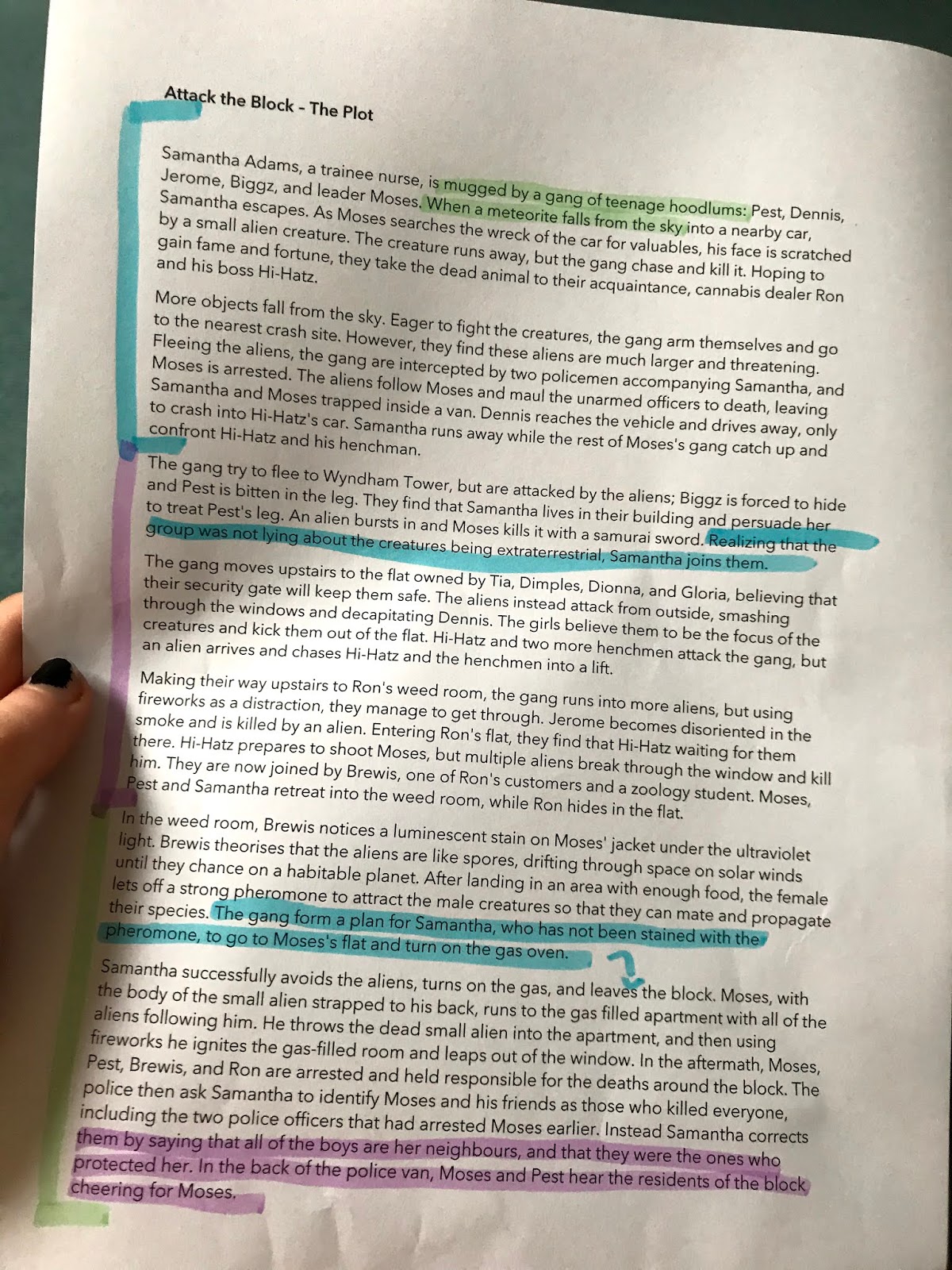
IN ATTACK THE BLOCK it is from Sam's perspective as we are shown Moses from her perspective. When she gets mugged by HIM, we don't like him and make an assumption... but as she realises, later on, we grow to understand and like him, along with her.
NARRATIVE PLOT
plot- plot, what we see and understand,
story, we know what he's doing.
PLOT IS REALLY WHAT WE SEE.
Story is EVERYTHING, even things we don't get to see as the audience.
Aristotle
- 'All narratives have a beginning, a middle and an end.'
Tsvetan Todorov -
- Bulgarian French literary critic.
- He said all could be broken down into 5 stages
equilibrium - normality, calm before everything just goes wrong and all bad ah no!
disruption - the story changes WHAAA, Something goes wrong, a death, event, situation
recognition - we know what's gone wrong and need to fix it RIGHT NOW
Attempt to repair - where they try and fix the situation restoration of a new equilibrium, where a new, or previous normality is restored. This does not have to be a good end, it can also be utterly awful for the characters, group, or just WHOLE society.
Restoration of the new equilibrium: IN ATTACK THE BLOCK, the new equilibrium is that Moses has reformed himself, he's changed, different people in the housing estate can talk not one another. These didn't happen before.
Vladmimir Propp
- wasn't studying film exactly
- he was looking at Russian folk and fairytales.
- he studied them all tho look for commonalities between them
- He said there were 7 character functions.
- Interactions between characters (how they talk to each other)
- They are called functions to him.
Villian
donor
helper
princess
dispatcher
hero
false hero
in modern narratives, princesses do not need to be rescued, or female as we are more woke.
ATTACK THE BLOCK is an
unusual film as it doesn't have the clear cut role types
For example, is there a helper?
Villian - The aliens
donor - Rob
helper - Sam
princess - ?? The entire tower block?
dispatcher - Rob?
hero - Moses
false hero - ??
Clause Levi-Strauss
people see in binary opposites.
good = bad
fast = slow
hero = villain
peace = war
black = white
man = nature
empowered = victim
without these, there isn't conflict and isn't a narrative.
In attack the block human vs alien
police vs youths
strong vs weak
hurting vs healing
old vs young
lower class vs society
all the classes are against each other basically
action vs inaction
Thursday, 27 February 2020
Tuesday, 25 February 2020
Genre and audience ATB
This sheet (high res)
Genre and audience is very important
Attack the Block is a hybrid of action, sci-fi, and horror genres.
The codes and conventions of Attack the Block, starting with Action are; that it has a male protagonist, that the humans triumph, unlikely heroes, and with large explosions. These can be created by the use of male actors throughout and the use of explosives and special effects. The explosions were shot by ariel shots and with slow-motion editing to add emphasis. These tend to feed into the genre of action, however, since the film is not shot in a very large space with fast, expensive car chases, it is not shot in America (where most action films are often) and adding to this, it is in South London which is a rare location for such a film, these subvert the expectations.
Now onto the Sci-Fi conventions, in the film Attack the Block, one of the main genres is of course Sci-Fi. Because of this, there must be obvious codes and conventions. I'll start with the codes, then list the conventions to explain them. There are colour themes of metallics all the way through such as blues, purples, greys and blacks. There is also a smaller group of teenage boys fighting a larger, supernatural force. The conventions that explain the colours are that over the camera lens, coloured gels could be placed and lighting would be placed to create shadows to emphasise the tense atmosphere. The teenage boys aspect conforms to the conventions of the genre whereas the fact that it does not involve robots, spaceships or is set on another planet, these subvert the expectations from the genre.
Finally the Horror conventions of Attack the Block. There is low lighting/ very dark lighting throughout the entire film, as well as close-ups and obvious bloody violence. These are accompanied by the use of jumpscares and themes of isolation, where the characters are split up. The most obvious part is, of course, the monsters themselves. The conventions for these would be to use minimal lighting if any at all, very fast cutting editing techniques in post-production (for the jumpscares) and wide shots to show the characters alone, fighting the monsters by themselves. Most of this fits in with the genre of horror, yet it lacks suspense and doesn't have a singular threat killing them off one by one for their self-gain.
The genre has it's own audience
Set of people - see film just because genre that it is in.
Genre has very distinctive features
Some films blur the boundaries - these are called hybrids, where you can’t tell the genre.
The audience will expect these certain features in these films.
CODES AND CONVENTIONS - things you usually find in this genre.
CODES
Codes are like objects (parts of the film)
- Codes can be divided into two categories.
TECHNICAL CODES
-WAY equipment IS USED to tell the story in a film.
Horror - shaky camera, handheld, dolls.
Music has to be made (technical) but it also creates mood (symbolic)
SYMBOLIC CODES - ones that make you feel something, create meaning
Conventions (typical of genre)
Genre specific,
Usually used, expected use.
A convention in horror films would be characters being stupid.
Explain the code with the convention.
ACTION CODES -
SCI-FI CODES -
HORROR CODES -
Attack the block
Does not conform mostly to their genres
Sci-fi (mostly in space, American, robots, future tech) <- doesn't have all this.
Theorists, work in universities by people who just think about films all-day
Look what we humans have done.
Theories behind the genre.
.Daniel chandler
Shared between texts (films). We base genre based on the context and the form (what they are and what they look like)
‘Conventional definitions of genre tend to be on the notion that they constitute particular conventions of content (such as themes and setting) and/or form (including structure and style) which are regarded as belonging to them.
Deborah knight
Satisfaction is guaranteed with genre; the deferral of the inevitable provides the additional pleasure of prolonged anticipation’
The fact that the audience knows how the story is going to end but enjoys the journey on the way there, getting pleasure from knowing the ending.
Monday, 24 February 2020
Tuesday, 18 February 2020
P1 Further Ideas Generation
'Operations' is about a Scottish gang family who smuggles drugs and weapons around the country, which is obviously very highly illegal. They're based in what seems to be an urban apartment block. When an advocate for Greenpeace, a climate change charity (movement), knocks on their door, they see this illegal activity and make a run for it to tell the police and to hide; these people are obviously highly dangerous. It's a crime TV show about a chase with many twists and turns with the characters changing and adapting with the new situation, questioning themselves and what they stand for.
'Shiny' is a very character-driven, episodic TV drama. It follows the character of Stella after her dad is sent to prison. She suddenly finds herself alone after the hype and adrenaline of the trial (where the first episode starts). Then, she begins to isolate as she finds herself unable to relate to everyone else. Then one day, a bird flies into her window and she takes it in.
Wednesday, 12 February 2020
ATTACK THE BLOCK MARKETING - UNIT 1
ATTACK THE BLOCK
WHEN WE TALK ABOUT ADVERTISING ABOUT ABOVE THE LINE AND BELOW THE LINE.
Above the line = This is everywhere goes out to everyone, eg. a billboard. You don't know who will be looking at it, it might not be the right audience or it could be, but everyone is able to see it. A newspaper is also above the line advertising as it is going out to the whole of society even though some are targeted more towards different social groups, everyone has the OPPORTUNITY to see it.
They have a huge audience but the product is not always for everybody's taste.
Below the line = This goes out to selected people only using targeted marketing. Because apps such as YouTube, Facebook and Instagram track what you look at and google, they send out targeted ads as technology knows who you are and what you like.
This is much cheaper than Above the line advertising.
THE BASICS
The director was: Joe Cornish
The writer was: Joe Cornish
It was released in 2011 on the 13th of May.
Some of the cast were John Boyega, Jodie Whittaker and Alex Esmail.
In the UK, the distributor's company was Optimum Releasing and in the US the distributors were Sony Pictures releasing.
The budget for the film was £8 million but at the box office, it only took back £4.1 million.
The production company was Big Talk.
Attack the block was marketed by:
Having a website. This is an example of digital marketing which is also Above the Line as it is not targetted ads. As well as having a double-page spread in Empire Magazine which is a form of above the line, traditional advertising as well as posters that were put up.
If you clicked on the games tab, then it led you to all different ways the film was being marketed, such as the soundtrack being on iTunes where you could download the songs, which is an example of synergy (as they helped each other have more money than they could've alone). There was a successful game released along with the film.
When it comes to Below the line (digital) advertising, the film had social media accounts on Facebook and Twitter and these might come into your feed based on past things you'd looked for. There were also very good reviews from the guardian saying that the film was successful and that it was actually funny as well. This is a very good example of digital, above the line advertising.
The YouTube trailer was seen by 2,572,549 people and is a below the line form of advertising as the ads for it would've been targetted at people who might've seen relevant/ similar videos.
TARGET AUDIENCE -
Based off all the merchandise and the posters, I would say that the target audience would be mainly males between the ages of 18-27 as the themes are not subtle with drug use and the racism that occurs in the south London. The drug usage isn't strictly deterred or supported yet they do play a major role within the film and they aren't discouraged.
There's also quite a lot of representation in the film so younger audiences might not understand the deeper themes of the film like people with more life experience might be able to.
Subscribe to:
Posts (Atom)